Privacy-First · Local-Only · Open Source

Your AI agent that never leaves your machine

A powerful local AI assistant for file exploration, code analysis, semantic search, and multi-turn conversations. Built on LangGraph, Ollama, and FastAPI — all processing stays on your hardware.

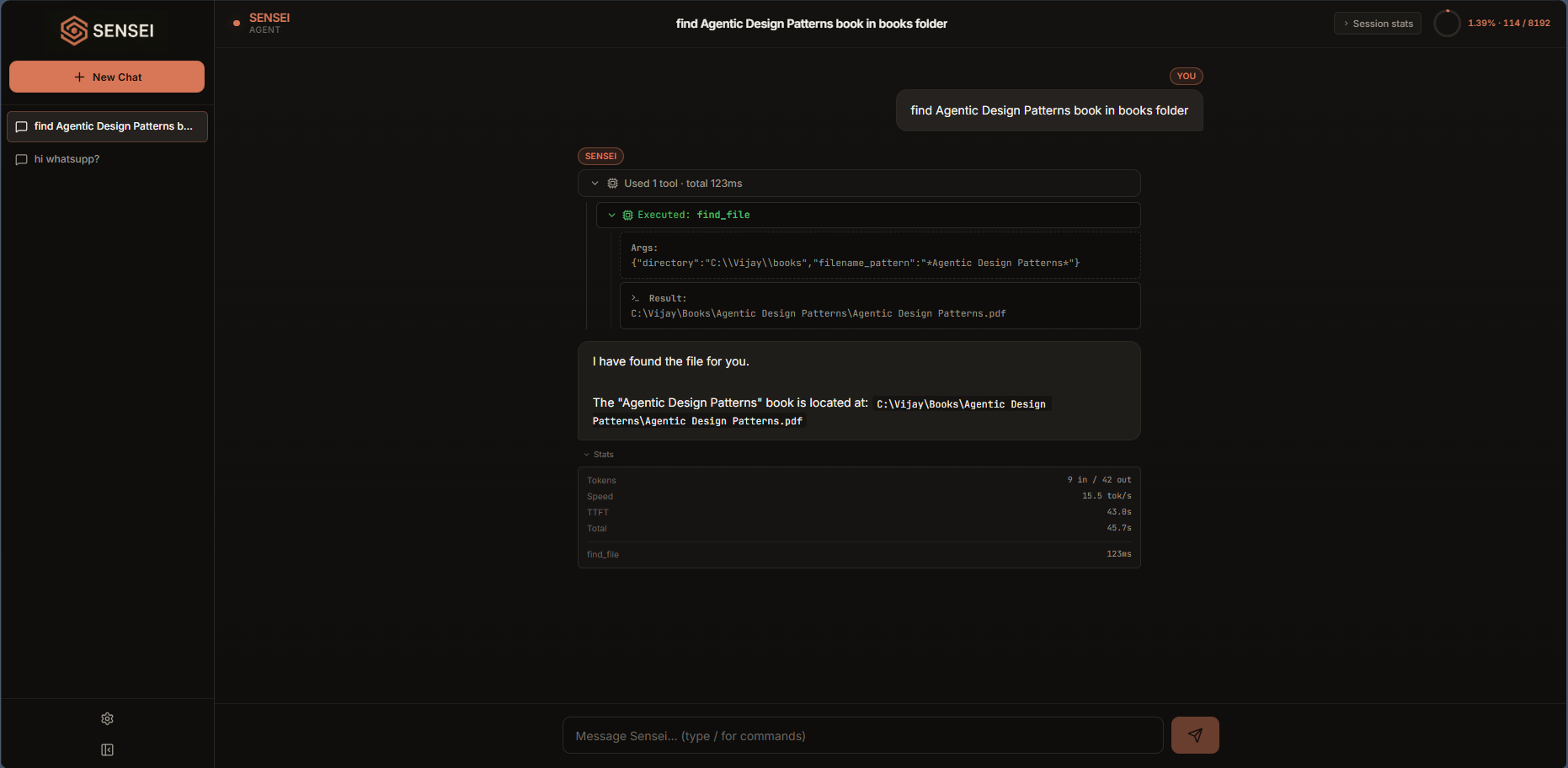
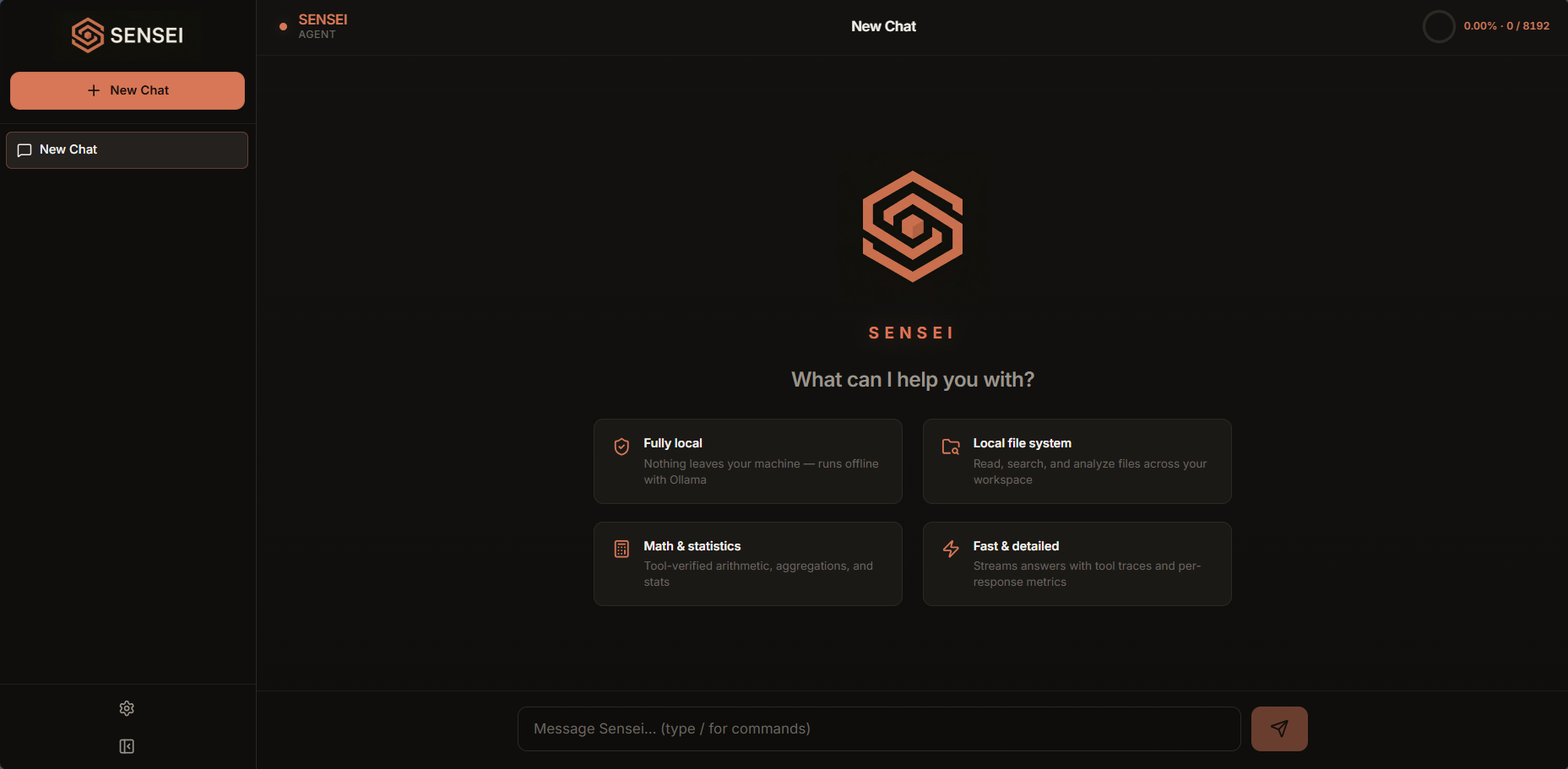
Sensei Chat UI — sidebar, capability cards, and message input
100% Local Processing
20+ Built-in Tools
15+ Slash Commands
0 Cloud Dependencies

Everything you need, running locally

Sensei combines deep file system access, semantic search, code analysis, and conversational AI — all without sending a single byte to the cloud.

Privacy First

All processing happens on your machine. Your files, conversations, and data never leave your hardware. No telemetry, no cloud calls, no data collection.

Deep File Access

Read PDFs, DOCX, code files, configs, images with EXIF data, and more. Regex search within files and across directories.

Code Analysis

AST-based Python structure extraction, directory tree visualization, git change inspection, and log file analysis. Understands your codebase deeply.

Semantic Search

Local FAISS-based embeddings for semantic search within files. Find content by meaning, not just keywords. Powered by Ollama embeddings.

Token Streaming

Token-by-token response streaming via SSE for a smooth, real-time chat experience. Watch responses appear as they are generated.

Multi-Session Chat

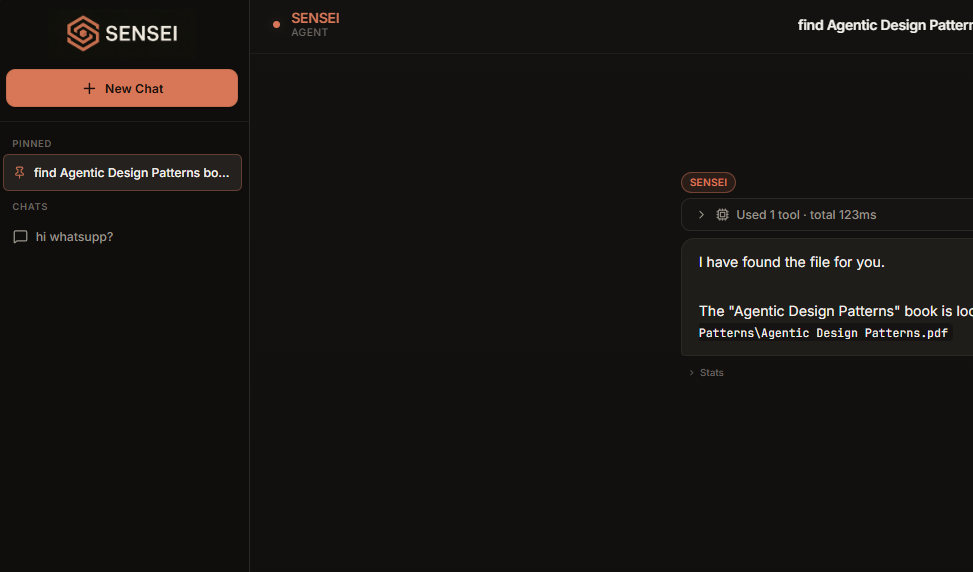
Create, switch, rename, pin, and delete sessions. Background execution preserves in-flight work when switching. Full SQLite persistence across restarts.

Context Management

Automatic summarization when context hits 75% capacity. Visual context ring indicator, conversation archive recall, and manual /compact command.

Observability

Per-response metrics: token counts, tok/s, time-to-first-token, latency, and tool execution durations. Session-level aggregate stats in the header.

See Sensei at work

A polished React UI with dark theme, real-time streaming, tool call visibility, and comprehensive session management.

Watch Sensei in action

Demo 1 — Core Capabilities

File exploration, tool execution, and streaming responses in action.

Demo 2 — Deep Dive

Session management, context tracking, and advanced tool chains.

Specialized agents for every task

Sensei is designed to scale to a multi-agent architecture with dynamic routing, approval-based handoffs, and team orchestration.

Sensei

Sensei

Default Agent

The core AI assistant. File exploration, code analysis, semantic search, document processing, and multi-turn conversations.

Default

Tesseract

Planner

Project planning, task decomposition, milestone mapping, and execution strategy. Structures chaos into actionable plans.

/plan

Arcane

Builder

Developer agent for code generation, refactoring, debugging, and implementation. Turns plans into working code.

/build

Zephyr

Brainstormer

Idea generation, option exploration, and structured creativity. Helps think through problems from multiple angles.

/brain

18+ Specialized Agents Planned

/researchDeep investigation & evidence-backed summaries
/devProject progress snapshots & blockers
/learnLearning paths & progress tracking
/tasksTask scheduling & calendar management
/googleGmail, Drive, Docs, Sheets workflows
/noteNotion integration & note capture
/blogEngineering content discovery & curation
/browseBrowser automation via Playwright
/jobsJob search & application support
/sysdesML system design mock interviews
/dsaDSA/LeetCode guided practice
/enhanceProductivity optimization
/chillMusic & content discovery
/navNavigation & travel planning
/socialWhatsApp/Instagram inbox management

20+ tools at Sensei's disposal

Every tool is transparently visible in the UI with execution timing and results.

Core File Tools

  • read_local_file PDF, DOCX, code, configs, images
  • get_file_metadata Size, dates, EXIF, dimensions
  • search_file_regex Regex search within a file
  • find_file Locate files by glob pattern
  • search_directory_regex Grep across directory contents
  • rebuild_file_index Rebuild SQLite file path index

Advanced Analysis

  • search_semantic FAISS-based semantic search
  • get_directory_tree Tree visualization
  • get_code_structure AST parsing (Python + regex)
  • analyze_logs Log file parsing & analysis
  • get_local_changes Git diff inspection
  • summarize_large_file Context-saving file summaries

Math & Stats

  • add subtract multiply Arithmetic
  • divide_decimal divide_integer_* Division
  • stat_mean stat_median stat_mode Statistics
  • count_values sum_numbers Aggregation

Memory & Control

  • recall_conversation Search archived messages
  • finalize_answer_from_tools Direct output pass-through
  • 15+ slash commands for session control
  • Interruptible runs with graceful cancellation

Built on proven foundations

A modern stack designed for local-first AI with production-grade observability.

Frontend
React 19 TypeScript Vite SSE Streaming
API Layer
FastAPI Uvicorn SSE Events REST API
Agent Core
LangGraph LangChain Tiktoken LangSmith
Infrastructure
Ollama (Local LLM) SQLite FAISS Tiktoken
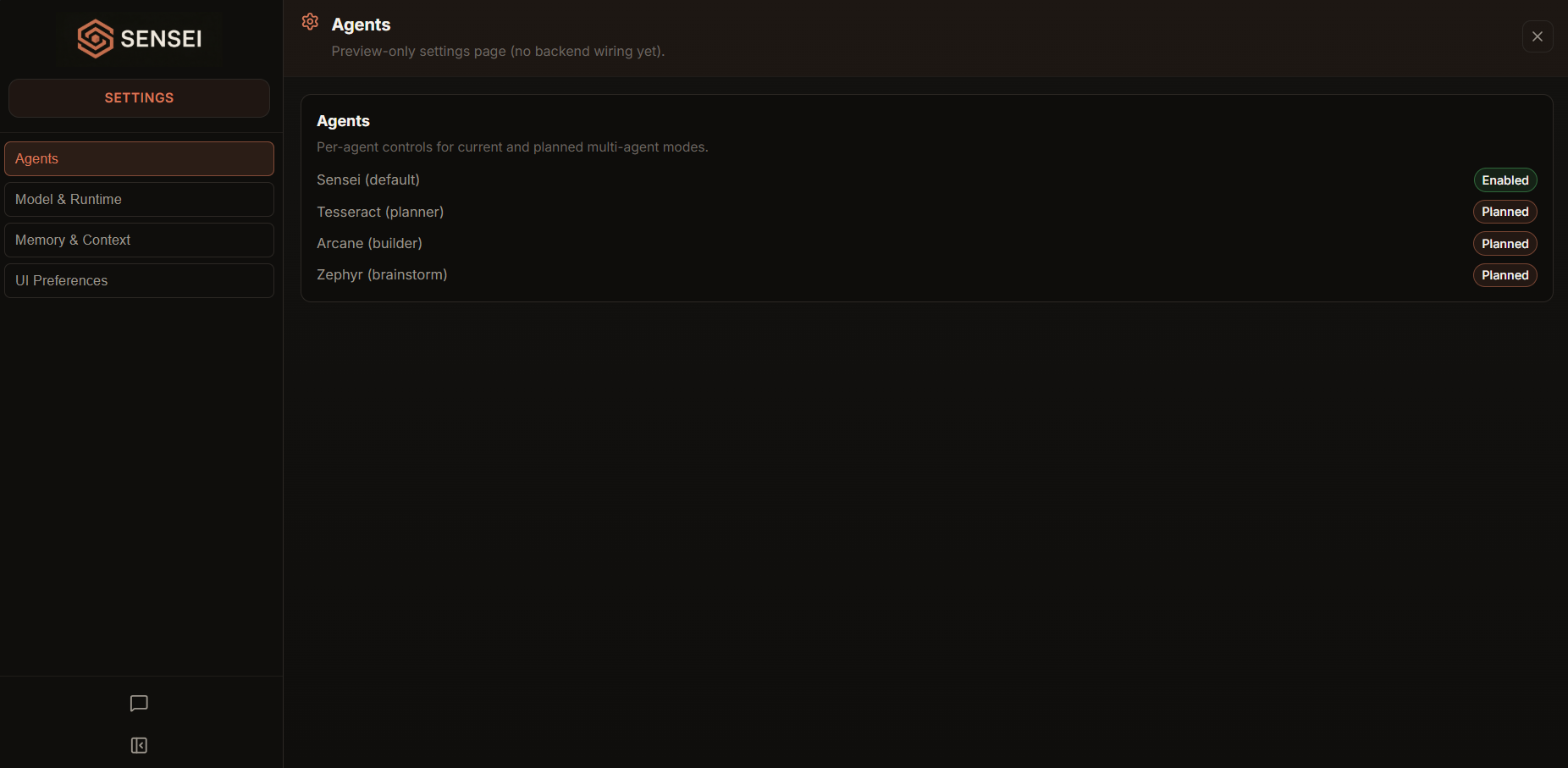
Sensei settings panel — agent configuration with multi-agent support

Power-user slash commands

Quick access to session management, context control, exports, and system status.

/compact Force context summarization
/summary Preview conversation summary
/context View token usage details
/clear Clear current session
/tools List all available tools
/export Export as JSON or Markdown
/search <query> Search indexed files
/index rebuild Rebuild the file index
/index status File index statistics
/agent status Agent and model status
/model Active model information
/history Recent session history
/help Show all available commands

Three-layer evaluation strategy

Rigorous evaluation ensures reliability from individual tool calls to final answers.

1

Tool Quality

Component-level correctness, robustness, and performance for each individual tool.

≥ 95% Success rate
≤ 1% Timeout rate
2

Agent Trajectory

Tool selection quality, argument correctness, retry behavior, and investigation chains.

≥ 85% Task success
≤ 2.5s TTFT p95
3

Final Answer

Task completion, groundedness, faithfulness, and hallucination detection.

≥ 0.90 Groundedness
≤ 5% Hallucination

What's coming next

Six implementation phases from foundation to production-ready multi-agent system.

Phase 1 — Foundation

Agent registry, per-agent policies, skills/rules framework, SQLite config persistence.

Phase 2 — Runtime Routing

Specialized subgraphs, explicit/dynamic/fallback routing, approval-based handoff protocol.

Phase 3 — Commands & Teams

/plan, /build, /brain slash commands. Team orchestration with sequential execution and approval-gated handoffs.

Phase 4 — Settings UX

Full settings page: enable/disable agents, model overrides, tool policies, skill/rule editors, and agent config APIs.

Phase 5 — Sub-Agent Fan-out

Bounded task decomposition with max depth 2, max 3 concurrent sub-agents, and hard timeouts.

Phase 6 — Production Rollout

Security validation, server-side policy enforcement, audit logging, and production trace tuning.

Planned Integrations

GitHub
Notion
Gmail
Google Docs
Google Sheets
Google Drive
YouTube
Spotify
Google Maps
LinkedIn
WhatsApp
Instagram

Up and running in minutes

1

Clone the repository

git clone https://github.com/VjayRam/project-sensei.git && cd project-sensei
2

Install dependencies

uv sync
3

Pull an Ollama model

ollama pull gemma4:e2b
4

Start the backend

uv run uvicorn src.server:app --reload
5

Start the frontend

cd frontend-react && npm install && npm run dev

Prerequisites

Python 3.12+ uv Ollama Node.js 18+ npm

Get in touch

Have questions, ideas, or want to contribute? Reach out through any of these channels.